
Colorado Universal Food Pilot Offers Promising New Strategy To Battle Food Insecurity
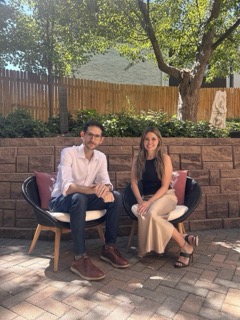
A year-long pilot in Colorado provided no-cost groceries to people in Denver and Del Norte, aiming to help people struggling to make ends meet — even if they aren’t eligible for SNAP. Spotlight spoke recently with Colorado Food Cluster CEO and Founder Kristen Collins and principal Strategy Advisor Jack Becker about the program, the learnings from the pilot, and what might come next. The transcript of the conversation has been lightly edited for length and clarity.
Why don’t we start with a little background about the Food Cluster.
Kristen Collins: Sure. I'm Kristen Collins, the CEO and founder of Colorado Food Cluster. We started as a program during the pandemic under another local nonprofit doing meals and meal deliveries for kids when all of the afterschool programs and schools were closed. We were supplementing the services school districts were doing and doing direct deliveries and enrollment.
Once the pandemic ended, we still overwhelmingly heard a need for food access, so, we pursued long-term flexibilities with the USDA and the Food and Nutrition services to do National School Lunch Program-type home delivery. And we met the Morgridge Family Foundation in 2023, and Carrie Morgridge introduced us to the concept of a food utility, which was coined by New Impact, which is another research company. They had done stakeholder engagement on coming up with a solution for food insecurity, given that there's so many resources, and why are there still so many people experiencing hunger. They asked if we would be willing to build a program and test it and see what this idea looked like in reality. So, we built a plan and we piloted a 12-month program that ended in July.
This is the first time the idea has actually been tried?
We are the only entity that has explored a truly operational universal food program where participating community members can shop at their neighborhood store and select healthy food items at no cost. Other items like sodas or unhealthy foods are out-of-pocket costs and the participants have to pay for those. There were no income requirements. The eligibility was based on access to the store, and they did have to reside in the zip code or an adjacent zip code of the participating grocery store.
Jack Becker: We had two stores in two communities in very different parts of Colorado. One was in Del Norte, which is an extremely rural part of the state. It's in the San Luis Valley, very close to the New Mexico border. And the other was in Denver, which obviously is the political and population capital. The store in Denver is part of a larger chain, Save A Lot, which owns a number of stores in Colorado, as well as some other states. In Del Norte, the store was owned by someone in the local community.
And the foundation was the major funder, but you also got funding from other sources?
Collins: Proportionally, the foundation was the second largest, as we also had federal funding secured by Sen. (John) Hickenlooper. The total budget was about $2.1 million.
How do you choose people who participate?
So, we opened up an application, we did local, geo-targeted ads to the zip codes of eligible areas. Everyone that applied had to sign a consent. And then we applied analytics to mimic population based on census data, household sizes, etc. If there were 30% single households, then we tried to make 30% of our participants that were selected single households. We didn't review in depth any of the applications we received. We only looked at zip code, their address and household sizes for the actual selection.
How many people participated?
Becker: 181 individuals across the program. And that represented 64 households and 181 individuals. And 60% of our population has participated or is participating in SNAP or WIC.
I'll just say that in terms of the selection, we worked through trusted folks in the community, community-based organizations and the grocery sites themselves to sort of get the word out. And I think that's reflective of this being a pilot trying to understand what it takes to deliver on a universal basic food benefit. What does it take to enroll and what does that look like? How do you seamlessly do that?
If you think about the traditional emergency food supply system, that is people accessing food at a nonprofit or a religious institution, there is sort of this ethos of serving the food, right? The sites that have maximized the potential of that interaction have created certain wraparound qualities such as additional benefit navigation and enrollment and have done a great job of staffing up around that and trying to make that a dignified experience. And on the other end of the spectrum is more of a handout-type charity.
It's a little different when you think about a benefit being delivered in a market and a relationship between a grocer who may not even be the owner of that store, and a cashier who may be there for a very short period of time. So, there was a lot of thinking and learning about how that can be seamless and successful and dignified, particularly as we built toward scaling up.
So, as much as providing needed food, it's also key to develop food consumers and a relationship in the community between the market and the people buying the food. And Snap is obviously a completely different model.
That’s right. And in addition to that, when you ask people where do you want to get your food, they say, my neighborhood store. They don't say, I want to line up. Now, some food banks are doing a great job having much more expansive hours and even creating their own markets. This is not about saying, hey, that's wrong. I think it's about how we push the food-industrial complex in a greater direction. Because we know that food and nutrition security continues to be a problem and has not improved since the pandemic where we saw rates skyrocket.
And in fact, the problem has become greater in so far as many grocery stores have become more efficient at reducing their waste, keeping stock on the shelves, so they have less to donate and that causes food banks to purchase food, creating more pressure on the philanthropic system. Our thinking is, is there some disruption that can help move things in a direction that gets people to what they're telling us they want, which is they want choice, they want to go to their neighborhood market, they want to buy relevant, fresh food items. They don't want to stand in a separate line. They don't want to use a voucher. They'd ideally like to not have to use a separate payment card. And we’ve really tried to solve that problem with what ended up being our custom-built loyalty model, which has proved quite successful in terms of being seamless, having virtually no error rate, and offering discounts on appropriate items.
And by loyalty model, you mean you can use this benefit at a specific store?
Correct, similar to what many grocery store chains do, where you punch in your phone number and you have member rates or rewards you accrue. We tell the system based on who a participant is, what their balance is, and what the eligible items are. We’re able to take care of things at that phase of the transaction rather than worry about actually transacting money. We’ve basically a custom web app where we have all the information about what a store's inventory is, and then we get to label the items that are eligible within that inventory. There's nothing different that they have to do as a participant and there's nothing different that a cashier has to do. They don't have to be trained really in any different way.
What comes next now that the trial has ended?
Collins: We're going to analyze the data and dive into any type of analysis or assumptions we can make from the shopping behaviors and trends. Like Jack said, we are able to get the entire cart of the participants. Participants had to complete a baseline survey for the research and that asked a bunch of questions about public programs so that we can analyze what improvement, if any, the program has made to their financial health, not just in nutrition benefits, but stable housing, mental and healthcare utilization, emergency room visits, prescription refills, those types of things.
Participants are required to complete four surveys, including one three to four months after the program has stopped to get a snapshot of their current situation after the programs ended. So, we'll analyze that and then we're hoping to release or make available some of the report on our website or publicly. And then we're also simultaneously planning, prepping, and building the next phase of the project to expand or explore more of the universality of the program where Colorado Food Cluster is not necessarily the one paying for all of the food for participants, but that we're leveraging this network of food subsidies, like the sugary beverage tax.
We also want to look at some food as medicine type of programming and explore a more restrictive list of healthy items and decide which, if any, nutrition-related diseases we want to focus on
So, does that mean phase 2 would be a larger pilot?
Becker: I think that to Kristen's point, if one of the core learnings is that there's an opportunity to more seamlessly integrate how we deliver healthy food and food nutrition insecurity benefits, we see various buckets that we can utilize the infrastructure and the learnings of the program to pull in. One is food as medicine, and we see that extending into Medicaid, Medicare and other programs in the future. There's a lot of momentum there.
Another bucket is healthy eating programs. The sugary beverage taxes are an area where we're seeing more counties and cities and other municipalities in Colorado as well as nationally that are really interested in passing those and then spending the funds on ways to incentivize healthy eating. We see that as another payer type and category that could function off of the food trust infrastructure we built. The third is continuing to think about the universal basic food benefit as a model. Ultimately, we do think can have some legs.
But I think fundamentally when you think about the food utility and the UBF concept, it sort of operates on a belief that our institutions will be stronger and our programs will be stronger when everybody has buy-in. That will continue to be our north star: how do we get more buy-in rather than having people think about programs as for someone else?
Are you looking at incorporating any kind of work requirement into the program given that’s the current focus in Washington?
Collins: So, ideally, we want this to be a program that survives some of the political ups and downs and confusion. We want this to survive all of that and be bipartisan supported. That's the universality. It's a program for everyone, not for them.